CLAUDIU IONESCU
talking to
Ill & MP JAMES DEAN COLE
Sovereign Grand Commander of the Supreme Mother Council of the World of AASR
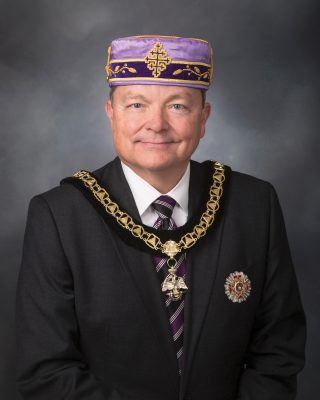
Our very special guest is James Dean Cole, 33, the Illustrious and Most Powerful Sovereign Grand Commander of the Supreme Mother Council of the World of the Ancient and Accepted Scottish Rite, from Washington D.C. I am deeply honoured because you accepted to grant us this interview. Many thanks, Brother Jim!
Thank you. It’s my pleasure and honour to be interviewed by you and I very much look forward to our conversation.
Thank you again. My dear Illustrious Brother Jim, please tell me you thoughts on the latest edition – the 21st – of the World Conference of the Supreme Councils, that took place in Bucharest in May of this year [2025]. The floor is yours!
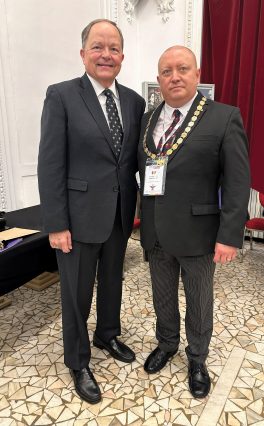
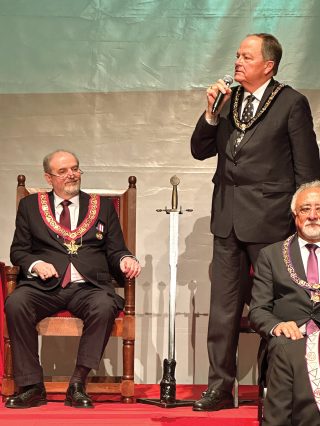
I was very pleased. Honestly, I had not visited the beautiful country of Romania before and I was pleasantly surprised at the beauty of the country, of the architecture. The meeting was conducted very well. I think we had wonderful opportunities to meet among the Supreme Councils – I think there were 59 Supreme Councils that were in membership at the Conference – and, also, the fraternalism that went on, not just in the meetings, but particularly away from the meetings. Generally at these conferences, their real value is the opportunity to meet face to face with one another, because we do not have those opportunities: particularly for those from North America and South America and Africa to be able to meet and mingle with and have conversations with the leaders from the European countries. Within the European countries, because they are much close geographically, they are able to communicate much more frequently in person. Once you bring everyone together, it’s just a wonderful feeling to be able to talk to people from around the world about Freemasonry and understand what we have in common, understand that we have similar issues that we tend to struggle with. It was a very good Conference in that sense. To me, the most important thing that came out of the Conference was that it offered membership within itself to the two Prince Hall Supreme Councils from the United States. Of course, that is a recognition of the long-standing issues that have been overcome within the United States. But those were really issues that were impressed upon the Fraternity in the United States because of American society, over a couple of hundred years. To see Freemasonry overcome those societal issues was very rewarding to me. I’ve worked on that particular issue for most of my Mason career – the recognition and acceptance of Prince Hall Freemasonry. That made it a very special time for me. We planned future meetings, we are planning to meet in Peru in five years and then on the African continent five years after that. So we planned the future sites, we did agree that the Accreditation Commission – which I currently chair – would continue in place until the next Conference. That will allow us to thoughtfully evaluate and work on fraternal recognition issues within the World Conference as we go forward, rather than waiting only a few months before the next Conference. We had good food, we had good entertainment, good weather and we were able, because of a very well-planned agenda, to enjoy a beautiful country. The architecture, the history that is involved with Romania was very enjoyable for me to participate in.
Thank you so much. I have often heard – and I also dare to consider – that the Scottish Rite is the “University of Freemasonry”. Is the Scottish Rite more offering than other appendant bodies? What do you think?
I very much believe in that statement. For example, we publish more books within the Scottish Rite, probably, than all of the other appendant bodies combined. In the Southern Jurisdiction we have a correspondence course called the Master Craftsman Program, we have the Scottish Rite Research Society, which does research in Masonic history and into the esoteric topics. We emphasize education throughout our organization. In the Southern Jurisdiction we support financially the continuing education of young people so as they attempt to attend college, we provide financial scholarships for them. We also fund RightCare programs which assist children with their language disorders in an effort to allow them to more fully and effectively engage in education as they go forward. As their communications improves, they are able to become more educated individually. So, we have a lot of reasons for that. Our Degree structure, if you think about the Scottish Rite Degrees, provides additional insights to the basic Blue Lodge, or the first three Degrees of Freemasonry. Therefore, we are in the education business even within our Ritual, because we are providing further information about the original Masonic story.
In various countries of the world there are problems between Grand Lodges and Supreme Councils, generated by the hugeness of the ego of the leaders. Please be so kind and give a lesson on this matter to those who consider themselves absolute gurus. You were also the Grand Master of the Grand Lodge of Virginia in 2001, so you can speak from both points of view.
I was Grand Master twenty-five years ago, almost, and I do have an appreciation of the challenges that Grand Masters face. Because of my work during those twenty-five years within the Scottish Rite I also have an appreciation of the challenges that Scottish Rite and other appendant bodies have in dealing with Grand Lodges and Grand Masters. We all have egos, we all have a certain amount of our own pride. What I try to remember is that to me the most important working tool or symbol of a Master Mason is the Level. I just met with forty Grand Masters at the Imperial Shrine session and I spent two days in conversation with them, facilitating discussions among those Grand Masters. I was a Past Grand Master, I had two colleagues that were working with me to run this meeting who also were Past Grand Masters, so there were forty-three Grand Masters and Past Grand Masters in the room – how could we possibly discuss things? As I suggested to them at the beginning, we have to remember that the Level teaches us that we should meet every Master Mason on the Level. It doesn’t say “you don’t have to do that if you hold a particular office” – it says “you have to do that”. So the challenge when I was Grand Master was to make sure that while I did not surrender the responsibility or authority of the office, I communicated with every single member on the Level. Whether that member happened to be a Worshipful Master of Lodge or a Grand Lodge Officer or the head of an appendant body, such as Scottish Rite, I communicated with him in the same manner. I feel strongly that regardless of your title there are certain ways that you should not communicate with another Master Mason. You should not, as we say in American English, you should not talk down to anyone – you should meet them on the Level and communicate on the Level. That doesn’t mean that you surrender your ability to make a decision or that you surrender your ability to properly execute your responsibilities as a Grand Master or, in my case, as a Grand Commander. When I approach a member as a Grand Commander, for instance, I try not to use to refer to my title a lot. I try not to have in my conversation a reference that says “Well, I’m Grand Commander, and because I’m Grand Commander I’m going to do X, Y and Z” – I don’t do that; what I try to say is “What is the best thing that we need to do? What’s best for the situation? Why are you doing that or why would you not do this?” instead of saying “I’m Grand Commander and I tell you to do this”, because I do not feel that I know everything. When I was in early grade school, probably my favorite teacher told me: “The day that you stop learning is the day that you start dying.” So if you’re going to live another day you’ve got to learn something today. For me, one of the reasons I meet people on the Level, even before Freemasonry, is because I know that I can learn something from every single person I meet. I don’t know everything. So in any situation, if I have to use my title, to say “We’re going to do this because I’m the Grand Commander and I said so”, that means that I was unable to properly evaluate and explain the situation. Also, if I have to use my title to get something I’ve probably failed, in my mind. In order to best overcome this, around the world, I always encourage leaders to meet other leaders and their members on the Level. That doesn’t give up anything, doesn’t take away any titles. To me, that’s the most Masonic action you can take in life – to meet everyone on a level manner, because no one likes to be put down and talked down to. Everyone likes to be appreciated, and when people are appreciated you see the full picture of them. When they are put down, you see a resistance that comes up and you’re not going to get the full story, you’ll never find out the extent of the problem if you try to find it with a stick in your hand to beat on someone. The only way that you will find all of the information is to meet someone on the Level – then they will open up. No one opens up to someone that they feel is so far above them, and therefore you should not act above other people.
This was a real lesson in leadership. Thank you very much. I hope some leaders will learn from this part of the interview. Brother Jim, what is the most difficult problem facing Freemasonry today?
There are two difficult problems. One we just talked about. We have a problem, at all levels of our Fraternity – and this could be in the Lodge, or in the Consistory of Scottish Rite –, that we don’t meet one another on the Level. The second problem is we are poorly equipped to communicate to non-Masons who we are and what we do. For many reasons, we are not as capable as we should be of communicating to a non-Mason about what we do and who we are. I think part of that, if you think back to our early ritual, a lot of our early ritual is about protecting our secrets, yet we don’t explain to our members where the secret stops and information that we can share begins. We also do not train our members on what to say, how to answer questions about the Fraternity. So because we don’t know how to communicate who we are and what we do we then build on that aura or perception by non-Masons that we are a “secret society” and we do bad stuff. Of course, nothing could be further from the truth, but we’re not communicating. So our ability to communicate to non-Masons is one of the two big problems that we face.

Do you think that nowadays the world needs Freemasonry like in the past? Has Freemasonry somehow eroded? Has it become more of a charity organization? What is the situation in the United States?
I think the world, but especially American society, needs Freemasons living in a Masonic manner more than ever before. I think the principles of Freemasonry certainly built this country, Freemasons were leaders in the establishment of this country, and I think if you look around the world you will see that many of the countries were started or were built up or their civilizations were greatly enhanced by members of the Masonic Fraternity. So I think, yes, clearly we need that. Again, this whole approach of meeting one another in the Level – if you simply look at social media and the news from television and other places and you see people talking down to other people, or criticizing, or instead of trying to learn from one another and to learn together they’re calling one another names and they’re saying hurtful things to other people, or they’re giving one version of the truth, or half the truth, and thinking that’s the whole truth, when it’s not. You have truth on the one hand and a lie on the other, but people sometimes tease me that I’m very black and white in that. But, as I’ve told my children as they were growing up: “if you’re not telling me the truth, then you’re lying, and you better hope I don’t catch you lying to me”. I think that the principles of Freemasonry, if they were more acted upon by people in society, both Mason and non-Masons – in other words, if they’re meeting one another on the Level, if they’re treating one another fairly, if they weren’t talking about people behind their back, if someone, when they made a mistake, they would go to him and put their arm around him and whisper good council in their ear, all these things that Masons promise to do – clearly the society in every country would be better.
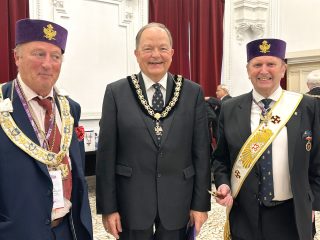
I kindly ask you to share with our audience your outstanding international Masonic experience. Are there differences between Eastern and Western European Freemasonry? Between South and North America? What kind of Freemasonry do you think is closer to what Freemasonry should be? Please describe the similarities, tell us about the differences in the way of various local approaches to the Brotherhood.
First of all, I’m not an expert on the ritual, even in certain parts of my country, let alone in many countries around the world. What I will tell you, though, is this: in the United States and in other parts of North America and South America there is a tendency to have Freemasonry emphasized for a much broader demographic audience. Within Europe especially, there tends to be a more narrowed scope as to who Freemasonry is directed towards within society. Part of that has to do with the approach to Ritual. In particularly Europe it is much more methodical and it takes longer to move through the Degrees. There are what we refer to as reunions. With a class reunion you can walk into that building as a Master Mason and you can leave the next day afternoon as a 32nd Degree Scottish Rite Master Mason. In many countries they do not go all the way to the 32nd Degree, hardly ever, very rarely. In the United States Scottish Rite, a full membership is regarded as being at the 32nd Degree, and that generally occurs in a matter of weeks or days. In other parts of the world, for example England and Wales, typically the 18th Degree would be considered to be a full membership in Scottish Rite, and everything above that is more of an honorific Degree or title. That varies around the world. For instance, it varies around the world how many active members that a Supreme Council has. Some have several dozen, England and Wales have nine, the Southern Jurisdiction – my Supreme Council – has thirty-three, the Northen Jurisdiction – which we border – has sixty-six. The numbers even within that differ. As far as which one of these is better, here’s what I say, even within my own jurisdiction. We have to recognize that every Masonic body really anywhere in the world is embedded in a particular culture. Every Lodge within the State of Virginia, where I was Grand Master, has its own culture. They’re used to doing certain things at their meetings, they’re used to having a certain meal at a certain time of year because that’s part of who they are. Anywhere in the world, so long as good men are getting together and they are building a bond based upon our generally shared principles, then that is the best Freemasonry for them. It’s not the best from one country to another, it’s very difficult to transport that, because the cultures are different, the men grew up in a different society, they faced different problems, and therefore, as they come together, as long as there is a Fraternal cement that is binding them together, then Freemasonry is working there. So whether the Ritual has 32 Degrees or 18 Degrees or whether you get one Degree a year – that doesn’t matter. It’s whether the cement of brotherly love and affection is working to bind those members together: then you have a successful Masonic entity in wherever that place is.
The Grand Lodges in English speaking countries are losing membership. What kind of policies do you recommend for maintaining membership?
This is one of the things that I discussed with those forty Grand Masters last week, and in fact that’s just the way I asked the question. We have to create a value within our organization. Our members have to know that we value them, but their membership, to them individually, has to have a value to them. We all do things that we value, as human beings. If we do not see value in something, we will tend to avoid it. If you thought I would not be able to answer questions or speak clearly, you would say “there’s no value in me having an interview with him”. Clearly, you make decisions based upon perceived value, so what we have to do is we have to build value within our members, to make them feel that what they have with us is valuable. Our emphasis, in my mind, needs to be on quality, not worry about quantity, which is the number of how many members we have, because if we build quality, in life quantity always follows quality. Quantity never creates quality or value. Just because there’s ten people doing something doesn’t mean that the eleventh person will come along, because they might think “Well, ten is too many”. If ten people were gathered around a pie to eat, the eleventh person is going to get a smaller piece of pie. If ten people were gathered around a pie and looked like they’re enjoying it and they said “This is the most delicious pie I’ve ever eaten”, then the eleventh person may very well say “If it’s that delicious, even a very tiny piece of it would be worth having”. So numbers do not drive quality, but perceived quality drives numbers. We have to make it valuable for the member, and the challenge there is that we have members with a lot of different perceptions, needs, preferences, and therefore we have to determine what they want and then be able to provide it to them.
The public perception of Freemasonry has changed over time. What has led to these variations? A good public perception results in an increase membership.
First of all, I think that what you just said varies around the world. In some places, particularly in the countries were Freemasonry is relatively new, compared to being 200-300 years around, I think it’s viewed a little more positively because it has not become, as we say, “old news”. Going back to what I said earlier about the ability of our members to communicate – I think they’d be more willing to communicate who they were and their pride in Freemasonry 100 years ago than today. Part of the reason for that is there are a lot of things that are competing for our attention and time. People can take their cell-phone and they can spend hours with that. As I was driving to work today, a car in the other lane was stopped and there was an opening several car links in front of it, and the drivers was impeding traffic. I looked over and he had his notebook computer propped against his steering wheel and was typing, when everyone was driving past him on the road. His attention was diverted to that instrument. Whatever he was typing on there was of greater value to him than driving down the road. But by doing that, it sent a message to me that he was not interested in driving down the road. So if we get distracted in our messaging, then the audience, the non-Masons, can get an inaccurate or inappropriate or wrong message from us. We have to be very focused in this, we have to communicate more directly than we have in the past. Again, a lot of that I think goes back to the average member really does not know what he can or should talk to non-Masons about.
How do you see the future of Freemasonry?
First of all, in terms of numbers, because everybody asks that question, I think that in America we will probably be less in number, but more focused and probably more effective in the next few years. The numbers are going down slightly. We’re not losing as many members each year as we were. The percentage of loss is becoming very small and I think that in time this means that it will level off and the numbers will actually increase, within probably a decade or so. If we can begin – and I think we are beginning – to more effectively communicate with non-Masons and with our own members, it will allow us to rebuild our reputation. As we continue to hopefully live Masonically, then we become more likely to be examples in the community and therefore have a more positive view from society of Freemasonry. I think that in the last year or two in America we are starting to see a slightly more positive view of the Fraternity than we have had in the past. My wife pointed out to me that just yesterday she saw on the news cast, in the opening section of this national news, a picture of a Square and a Compass. It was a picture of a Masonic building. It started there and panned over to Independence Hall and it said “On the 4th of July weekend, in the City of Brotherly Love”. Well, as it said “Brotherly Love” it panned across the Square and Compass. Five years ago, that would have been edited from the film. Now it is just a little bit more acceptable out there. I think that we’re starting to turn a corner in America. I think that in other countries that I have visited Freemasons are regarded more highly than they are in America. Again, that sort of varies by the history of the country and it goes back to what I was saying earlier about how the local needs for Freemasonry are what really define the culture I was talking about.
Finally, my dear Brother Jim, please let us know your resume, both profane and Masonic, please.
Professionally, I was trained as what in America is called “certified public accountant”, so I have my financial background. I worked in an international accounting firm for three years. They wanted to promote me to a national office and I did not want to move. I was engaged at the time and decided that I wanted instead to move from a financial career into the administration of a large public university by the name of Virginia Tech. It was actually where I obtained my undergraduate college degree. While there I obtained a Masters degree in education. In addition to my job I began a business in consulting. I consulted with several hundred different clients who were in what in America we call non-profit, or charities, as well as working at the university. I did not teach classes, I was an administrator that worked in the business part of it. Part of my job was to establish partnerships even overseas with universities and businesses. I helped open a campus in Switzerland, a European study centre for that university in Virginia, so that students would be able to travel and live in Switzerland during the summer and be able to travel around Europe and learn things about the culture and society. We even had engineering students that went over there and studied how bridges were built in Germany and things like that. I enjoyed it. Near the end of eighteen years in that position I became Grand Master in Virginia, and following my year as Grand Master in Virginia I ran the Masonic Retirement Community – in America it is a healthcare facility where people who are retired from work can go and live – for eighteen years. During that time I also became and instructor and an author. I wrote educational courses for CPAs and I taught ethics classes – in fact, they said I taught 83,000 students over the course of fourteen years. Then I resigned from that job to accept this job, which is a paid position at the Supreme Council. So professionally that’s what I did. Masonically, in 1983, just before I was married, I joined the Masonic Lodge, was raised to the Degree of Master Mason on July 19th, 1983. In 1985 I was appointed to a Grand Lodge Committee and office, then in 1991 I became the chairman of our Grand Lodge Finance Committee – that was the same year I joined Scottish Rite. When I joined Scottish Rite, ironically I was the first person to receive the revised 4th Degree – they adjusted the Ritual and I was the first person to receive it. The Supreme Council came in and witnessed that. I didn’t even know what the Supreme Council was, but they knew me, apparently. Then I became Grand Master in 2001. The next year I was appointed as a Deputy of the Supreme Council after I went out of office as Grand Master, and then I became an active member a few months later. I am a member of the International Shrine Organization, of several York Rite bodies. I have received honours and awards from a lot of them, which certainly I don’t think I deserve, but somebody thought I deserved them. I am an honorary member of fourteen different Symbolic Lodges that have awarded me honorary membership and of several Supreme Councils, which are similar to the honorary memberships in subordinate Lodges. In terms of seniority, in addition to being Grand Commander, I am currently the senior serving active member of the Southern Jurisdiction. I became an active member in 2003, the next most senior member joined in 2005. I’ve been married for forty-two years, my wife is extremely supportive of Freemasonry. I have two children and five grandchildren. What I like to do when I’m not doing Masonic activities is to read books and play golf. That’s pretty much me in a nutshell!
Splendid! Thank you so much for this fantastic interview. As I said previously, it’s a real lesson for being a leader.